Via SchiffGold.com,
The gold market took a one-two punch on Tuesday as Trump made some
concessions in the trade war and inflation numbers came in a bit higher
than expected. Peter Schiff talked about it in his latest podcast,
saying gold traders still don’t understand the gold rally.
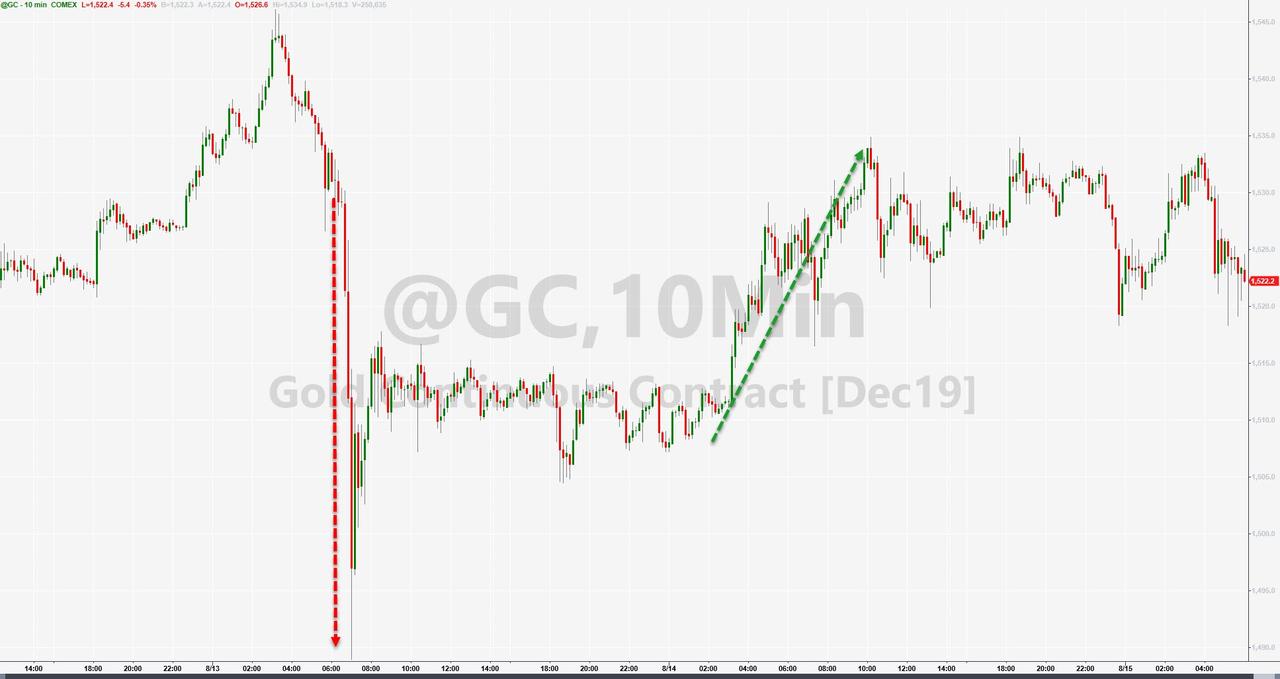
Stock markets surged as gold and silver dropped after US trade
representatives said they would delay some of the additional tariffs
recently announced by President Trump. The Dow closed 372 points higher
(before collapsing back 800 points lower yesterday). Meanwhile, the
price of gold dropped below $1,500 briefly before rallying back above
that key number.
Gold actually began selling off before the trade war news when the
Consumer Price Index number came in hotter than expected. Peter said he
knew that would happen.
That is the way the lemmings trade, because
according to the conventional wisdom, if inflation is higher, then the
Fed will be less likely to cut rates. After all, they’re cutting rates
because inflation is too low and if inflation comes in hotter, well,
then there’s less of a reason for the Fed to cut rates. So
paradoxically, higher inflation is seen as being bad for gold. And the
reason I’m saying paradoxically is because gold is an inflation hedge.
Normally, the more inflation the more you want to buy gold.”
There is no way the Fed is going to fight inflation. I don’t care how high it is … One of these days the traders have to realize that these numbers don’t matter. I mean, maybe they matter to the public who has to live with a rising cost of living. But they don’t matter to the Fed. The
Fed is going to take rates back to zero no matter what these numbers
are, because the economy is going into recession even as inflation
rises.”
As far as the trade war announcement goes, Peter said it just shows
that Trump was bluffing when he announced more tariffs. He said he
thinks it makes the president look very weak.
This trade war is lost. The only question is when do we surrender and how do we admit defeat. Again, I don’t think we’re going to get any kind of deal.”
Meanwhile, the mainstream is starting to talk about a looming
recession. They are also calling for the Fed to cut rates and go back to
QE. Peter said they still don’t get it. They don’t understand that this
time around is not going to be like QE1, QE2, and QE3 where everybody
made money.
I understood from the beginning that the Fed’s plan could not
succeed, that they could never normalize rates, that they would have to
go back to zero, that they could never shrink their balance sheet, that
they would have to call it off and do more QE, because I understood the problem back then, and I still understand the problem now, and I understand the consequences.”
Peter noted that New Zealand’s central bank recently cut its interest
rate by 50 basis points, basically in an effort to preemptively keep
inflation from dropping below its target level. He pointed out that
nobody wants a strong currency.
Everybody is weakening their currency to create more
inflation. Well, what’s going to happen? The world is going to drown in
an ocean of inflation and gold is going ballistic.”
The people who are selling gold don’t get it. Gold is not
going up because of the tariffs. Gold is going up because of what the
reserve bank in New Zealand did and because that’s what all the central
banks are doing …
Every central bank has bought into this nonsense that we must have
inflation and that interest rates need to be negative. Inflation needs
to be high enough to have real negative rates all over the globe. That’s
where we are heading. So, if that is the case, people have no place to hide except gold and that is why they’re buying.”
Peter said ultimately we are going to have a global currency crisis –
a US dollar crisis – because it is at the epicenter of the global fiat
monetary system.
Amazonで買物をしてContrarianJを応援しよう 記事を紹介しようと訳を入れている間にFOMCが過ぎてしまいタイミングを逸してしまいました、前半は読み飛ばしてください。後半部分に関して、日本では一般会計と特別会計が別れていて政府財政がわかりにくいですが、米国は分離されておらず年金会計がより鮮明になります。$70Tって邦貨でいうと約7000兆円ですからね。 Whistling Past The $70 Trillion Debt Graveyard 07-26-19 Written by Lance Roberts | Jul, 27, 2019 Last week, we discussed the setup for a near-term mean reversion because of the massive extension above the long-term mean. To wit: 先週には、私どもは短期的な平均回帰のし掛けが出来上がっていることを議論した、というのも現在長期的な平均から極端に乖離しているからだ。見てみよう: “There is also just the simple issue that markets are very extended above their long-term trends, as shown in the chart below. A geopolitical event, a shift in expectations, or an acceleration in economic weakness in the U.S. could spark a mean-reverting event which would be quite the norm of what we have seen in recent years.” 「とてもかんたんなことだが、市場は長期的なトレンドからあまりに極端に上方乖離している、それは下のチャートを見れば明らかだ。地政学的出来事、期待値の変化、もしくは米国経済の弱さが加速するなら、平均回帰を引き起こすだろう、それは過去数年でみた典型的な相場の動きだ。」 This analysis is ...
Productivity: What It Is & Why It Matters Written by Michael Lebowitz | Jan, 16, 2019 The Kansas City Federal Reserve posted the Twitter comment and graph below highlighting a very important economic theme. Although productivity is a basic building block of economic analysis, it is one that few economists and even fewer investors seem to appreciate. Kansas 市FEDがツイッターにコメントを投稿した、そのグラフを下に示す、とても重要な経済テーマだ。経済分析においては生産性というのはとても重要な要素だが、ほとんどのエコノミストがこの件に言及しない、投資家は更にこのことを忘れ去っている。 The Kansas City Fed’s tweet is 100% correct in that wages are stagnating in large part due to low productivity growth. As the second chart shows, it is not only wages. The post financial-crisis economic expansion, despite being within months of a record for duration, is by far the weakest since WWII. Kansas City FEDのツイートは100%正しい、給与が停滞している原因の主要因は生産性成長が低いからだ。二番目のチャートを見ても判るように、成長鈍化は給与だけではない。あの金融危機後の経済拡大は、第二次世界大戦後で記録的長期の拡大期間だが、とても弱い拡大だ。 Productivity growth over the last 350+ years is ...
この記事は投資人生を通じて有効です。 The Beginning is the End is the Beginning: A Look at Recessions Market Commentary Stocks By Liz Ann Sonders February 25, 2019 Key Points Recessions are not back-to-back negative GDP quarters; they’re instead defined using four key coincident economic indicators. 景気後退とはマイナスGDP成長四半期が連続することではない;そうではなく4つの重要経済指標で定義される。 Bear markets often overlap with recessions (and typically lead them), but not always. ベア相場は景気後退と重なることが多い(典型的には先行する)、しかし必ずそうというわけでもない。 It’s important to distinguish between leading and lagging economic indicators and to focus at least as much on trend as level. 大切なことは先行指標と遅行指標を見極めること、そしてすくなくともそのトレンドに注意せよ。 Recession chatter is abundant lately. It’s increasingly the focus of Q&A sessions at investor events at which I’ve been speaking. I also received a series of questions last week about recessions fro...
米国はよく理解してませんが、日本の場合では量的緩和で日銀が国債買い上げした資金は日銀当座預金にそのままです、市中には流れていません。でもNHKのニュース等では「ジャブジャブ」という表現をアナウンサーが使い、さらに丁寧に水道の蛇口からお金が吐き出される画像まで示してくれます。これって心理効果が大きいですよね。量的緩和とは何かを7時のニュースや新聞でこれ以上丁寧に解説するのはそう簡単ではありません。一般の人も株式をやっている人も「イメージ」で捉える以上はそう簡単にできません。多くの人は量的緩和とはなにか、を理解していないと私は想像しています。 ただし、国債を買い上げるので長期金利が低下し住宅ローン金利等が下がったのは確実な効果です。一方で長短金利差が少なくなると銀行のビジネスモデルが成り立たなくなりますが。 This Is The One Chart Every Trader Should Have "Taped To Their Screen" by Tyler Durden Sat, 01/19/2019 - 18:55 After a year of tapering, the Fed’s balance sheet finally captured the market’s attention during the last three months of 2018. 一年間のテーパリング後、FEDバランスシートがとうとう市場の注目をあびることになった、2018年の最後の3ヶ月だ。 By the start of the fourth quarter, the Fed had finished raising the caps on monthly roll-off of its balance sheet to the full $50bn per month (peaking at $30bn USTs, $20bn MBS...