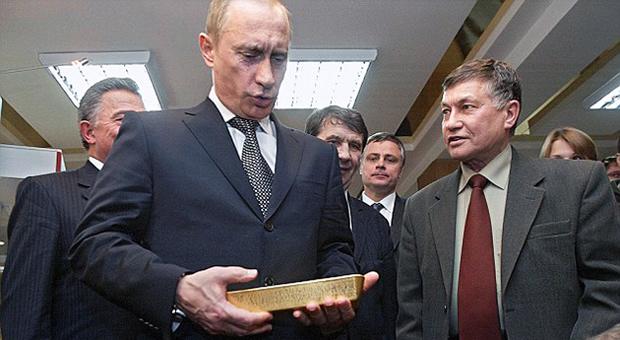
Authored by James Rickards via The Daily Reckoning, There’s nothing new about the Russian accumulation of gold bullion in their reserve position. It began in a material way in 2009 when Russia had about 600 metric tonnes of gold.
Today, Russia has 2,183 metric tonnes, a stunning 264% increase in less than 10 years. Russia is the sixth-largest gold power in the world after the U.S., Germany, IMF, Italy and France.
Russia’s gold hoard is over 25% of the U.S. hoard, but Russia’s
economy is only 8% the size of the U.S. economy. This gives Russia a
gold-to-GDP ratio over three times that of the U.S.
One reason is as a dollar hedge. Russia is the
second-largest energy producer in the world. Most of that energy is sold
for dollars. Russia can hedge potential dollar inflation by buying
gold.
Another reason has to do with the avoidance of U.S. sanctions. Gold
is nondigital and does not move through electronic payments systems, so
it is impossible for the U.S. to freeze on interdict.
Yet a deeper reason is that Russia has a long-term plan to subvert the dollar’s role as the leading global reserve currency. The Russian ruble is not positioned to be a reserve currency, but a new cryptocurrency backed by gold would be a good candidate.
The Central Bank of Russia will consider a new study that suggests
just such a gold-backed cryptocurrency to settle balance of payments
among willing participants. This plan is in its preliminary stages and
is a long way from reality at this point.
Still, the Russian endgame has now been revealed. The dollar’s days as the leading reserve currency are numbered.
それでも、ロシアの目指す終局は明らかだ。ドルが国際貿易決済通貨である時間には限りがある。
Of course, Russia is not the only nation accumulating gold as
a means to move away from the dollar. You can certainly add China to
that list, and many others. 当然のことながら、ゴールド備蓄を増やしドルから距離を置こうとしている国はロシアだけではない。中国も同様だ、他にもそういう国はある。 The latest move comes from Malaysian Prime Minister Mahathir Mohamad. He promoted the idea of a common trading currency for East Asia that would be pegged to gold.
The global monetary regime has collapsed three times over the past 100 years, in 1914, 1939, and 1971. They seem to happen about every 30 to 40 years on average. It’s now been over 40 years since the last collapse, so we’re due.
I read headlines all day and focus extensively, if not exclusively,
on gold. If gold is the best form of money (it is), and if gold had
unique properties as money (it does; it’s the only form of money that is
not also debt), then gold is well worth the focus.
With that said, it’s hard to surprise me on the subject. After a while, you think you’ve seen it all. Yet, there are exceptions. This headline stopped me in my tracks: “Bank of Russia may consider gold-backed cryptocurrency.”
The idea itself is not exactly new. I first suggested that Russia
might be acquiring gold with a view to a new gold-backed currency at a
financial war game hosted by the Pentagon at a top-secret laboratory in
2009.
In my upcoming book, Aftermath, I describe a more
sophisticated monetary arrangement among Russia, China, Iran and other
nations to use a gold-backed cryptocurrency for international
settlements.
Still, theory is one thing, reality is another. Here
was a real central bank taking real steps toward a gold-backed
cryptocurrency. Of course, the announcement came with lots of caveats
about the need to stick to hard currencies. This gold initiative
involves review of a report, not a live plan at this stage.
Still, it was a significant moment in the move away from the
hegemony of the U.S. dollar as the dominant global reserve currency
toward another system that included gold. それでも、世界的備蓄通貨としてのドル覇権を回避してゴールドを含む他のシステムへの移行を考える大切な時期を迎えている。
By itself, this announcement is not a reason to load up on gold. In
fact, the spot price of gold barely budged on the news. Gold prices are
far more likely to be affected by strength or weakness of the U.S.
dollar, real interest rates, inflation prospects and geopolitical
stress.
But, the announcement is highly significant in another way. It
signals that the demand for physical gold by major central banks is here
to stay. Whether a new gold-backed cryptocurrency emerges next year or
five years from now does not alter the fact that you need gold to have a
gold-backed currency.
Neither Russia nor China has all the gold it needs for that
purpose yet. Therefore, demand for physical gold will remain strong even
as supply has flatlined. ロシアや中国でなかろうがこういう目的のためにゴールドが必要だ。しかるに現物ゴールド需要は今後も強いものだろう、たとえ供給に変化はなくともだ。
This creates an asymmetric trading pattern where gold has good
potential to rise, but only limited prospects of a material fall. Those
are the best kinds of markets for trading and investment. Taking into
account both these fundamental and technical factors, what is the
outlook for the dollar price of gold and gold mining stocks in the near
term?
Right now, the evidence is telling us that the dollar price
of gold is poised to breakout to the upside after a prolonged period of
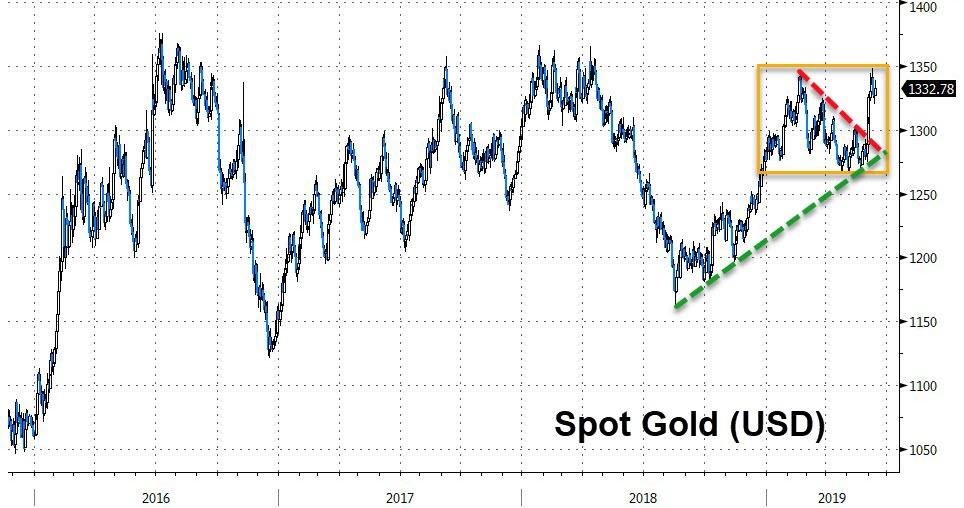
range-bound trading. 今の所、確認できるのはドル建てゴールド価格は、三角持ち合い状態から上抜けしたところだ。 Chart 1 above illustrates recent price action in gold and shows why the prospects are good for near-term price appreciation.
After a rally from $1,215 per ounce in late November 2018 to $1,293
per ounce in early January 2019, gold remained in a tight trading range.
That’s a range of about 2.8% above and below a mid-point of $1,305
per ounce. A 2.8% range is not unusual when governments try to peg two
currencies to each other. In effect, gold has been pegged to the dollar
at $1,305 per ounce.
However, this trading range exhibits another pattern called “lower
highs.” Each spike at the high end of the range is slightly lower than
the one before.
Conversely, the bottom in each gyration has been more
tightly bunched forming a kind of floor under gold prices.
逆に、変動の底値で確実に反騰しある種の床を形成していた。
The combination of a strong floor and declining highs results in a
compression of the trading range. What this pattern presages is a
breakout. Of course, the question is whether gold will breakout to the
downside or the upside. This week we saw gold break higher, to $1,345.
The evidence is strong that gold is poised for a sustained
upside breakout. The reason for the floor around $1,270 per ounce has to
do with fundamental supply and demand. Russia and China continue to buy
gold at a prodigious rate. ゴールドが持続的な上放れとなった証拠は強いものだ。$1,270近くの床は需給ファンダメンタルズによるものだ。ロシアと中国が引き続き桁外れの買いを行っている。
Russia has been buying between 15 and 25 metric tonnes per month,
sometimes more, for over ten years. Russia’s gold reserves now stand at
2,183 metric tonnes, over 25% of the U.S. total with a far smaller
economy. China is less transparent in its gold buying but also has over
2,000 metric tonnes, perhaps much more.
Neither Russia nor China have their targeted amount of gold yet, which would be 4,000 metric tonnes for Russia and 8,000 metric tonnes for China to achieve strategic gold parity with the U.S.
Iran and Turkey have also embarked on major gold accumulation efforts.
What all of these gold buying strategies have in common is a desire
to escape from dollar hegemony and the imposition of dollar-based
sanctions by the U.S. The practical implication for gold investors is a
firm floor under gold prices since Russia and China can be relied upon
to buy any dips.
The primary factor that has been keeping a lid on gold prices is the strong dollar.
The dollar itself has been propped up by the Fed’s policy of raising
interest rates and reducing money supply, so-called “quantitative
tightening” or QT. These tight money policies have amplified
disinflationary trends and pushed the Fed further away from its 2%
inflation goal.
However, the Fed reversed course on rate hikes last December and has announced it will end QT next September. These actions will make gold more attractive to dollar investors and lead to a dollar devaluation when measured in gold. しかしながら、昨年12月の金利引き上げからFEDは政策を反転させQTをこの9月に止めると言っている。これらの行動でゴールドはドルよりも好まれるようになりドルの減価となるだろう。
The price of gold in euros, yen and yuan could go even higher since
the ECB, Bank of Japan and People’s Bank of China will still be trying
to devalue against the dollar as part of the ongoing currency wars. The
only way all major currencies can devalue at the same time is against
gold, since they cannot simultaneously devalue against each other.
A situation in which there is a solid floor on the dollar price of
gold and a need to devalue the dollar means only one thing – higher
dollar prices for gold. A breakout to the upside is the next move for gold. ドル表記でのゴールド価格の底値が確実なとき、そしてドルが減価をする必要があるならーーゴールドが上昇するしかない。次のゴールド値動きは上放れだ。
Amazonで買物をしてContrarianJを応援しよう この長文記事をRay Dalioが発表し、ゴールドは$1400から$1420へと急騰しました。GLD保持高に変化はないのでたぶん先物ポジションが進んでいます。 Ray Dalio Warns A "New Paradigm" Is Coming: "Buy Gold, Sell Stocks" by Tyler Durden Wed, 07/17/2019 - 14:44 Authored by Ray Dalio via LinkedIn, One of my investment principles is: 私の投資原則はこういうものだ: Identify the paradigm you’re in, examine if and how it is unsustainable, and visualize how the paradigm shift will transpire when that which is unsustainable stops. 現在のパラダイムを認識し、それがどの程度持続可能かどうか判断する、そしてパラダイムシフトがどのように起きるか、そしてその着地点を思い描く。 Over my roughly 50 years of being a global macro investor, I have observed there to be relatively long of periods (about 10 years) in which the markets and market relationships operate in a certain way (which I call “paradig...
Amazonで買物をしてContrarianJを応援しよう Silver Outperforming Gold 2 Adam Hamilton July 26, 2019 3232 Words Silver has blasted higher in the last couple weeks, far outperforming gold. This is certainly noteworthy, as silver has stunk up the precious-metals joint for years. This deeply-out-of-favor metal may be embarking on a sea-change sentiment shift, finally returning to amplifying gold’s upside. Silver is not only radically undervalued relative to gold, but investors are aggressively buying. Silver’s upside potential is massive. ここ2週シルバーは急騰した、ゴールドを遥かに凌ぐものだ。これは注目すべきことだ、もう何年もシルバーはひどいものだった。この極端に嫌われた金属が大きく心理を買えている、とうとうゴールド上昇を増幅するに至った。シルバーは対ゴールドで極端に過小評価されているだけでなく、投資家は積極的に買い進んでいる。シルバーの潜在上昇力は巨大なものだ。 Silver’s performance in recent years has been brutally bad, repelling all but the most fanatical contrarians. Historically silver prices have been mostly ...