Money manager Peter Schiff says the Federal Reserve has already
started a new money printing program that continues to expand the debt
bubble and keep global markets propped up. This started abruptly last
month in what is called the “repo market,” where the Fed provides
liquidity for traders of short-term money or overnight funding.
Peter Schiffはこういう、FEDはすでに紙幣印刷プログラムを再開している、債務バブルを膨らまし世界株式市場を支えている。これは先月突然「レポ市場」で始まった、ここでFEDは短期的な一夜もの流動性を供給している。
Schiff says, “When the Fed was doing QE3, they were buying $85
billion worth of debt per month. They (Fed) just did $176 billion in
three weeks, and they say they are not doing QE..."
"So, the Fed is monetizing more debt not doing QE than when
they were doing QE, which means they are doing it and they are going to
have to do more of it. The reason they are doing it is because
the markets are finally trying to move interest rates higher because the
Fed has been suppressing them. They are artificially low, and these
artificially low interest rates have done tremendous damage to the
economy over the years. Now, rates are rising, and the Fed is trying to
stop this from happening. They shouldn’t do this, but this is what they
have to do to keep the bubble from imploding. This is why they
have to go back to QE. If they didn’t, rates would be much higher, the
stock market would be much lower, real estate prices would be coming
down and we would be heading for another financial crisis.”
What is the end goal in all of this? Schiff contends, “The only goal our leaders have is to postpone the pain so they can get re-elected..." この状況の到達点は何だろう?Schiffの主張はこうだ、「我々の指導者の唯一の目的は痛みを先延ばしし、再選されることだ・・・」
"That’s the whole idea. Look, this is a gigantic time bomb; we just have to make sure that the fuse is longer. We
have an election coming up, and the Fed Chair just wants to make sure
they can keep everything going long enough to resign and have somebody
else be the fall guy. Nobody cares about the long term health of the
economy, and the plan is to delay the inevitable and pretend everything
is good. . . . As far as the debt is concerned, the debt is never going to be repaid. We can’t repay it, and, in fact, nobody even believes we are going to repay it.”
So, what is the next move by central bankers?
Schiff says, “It’s more politically expedient to take the printing
route, especially because nobody believes they are going to destroy the
currency..."
"They think they are going to print enough money to reduce the value
of the debt enough to make everything go away. It’s like trying to get a
little bit pregnant, which is impossible to do. So, once they start
monetizing debt in that way, then that’s it. The dollar is going
to get killed. That’s where we are headed. That’s the only thing that
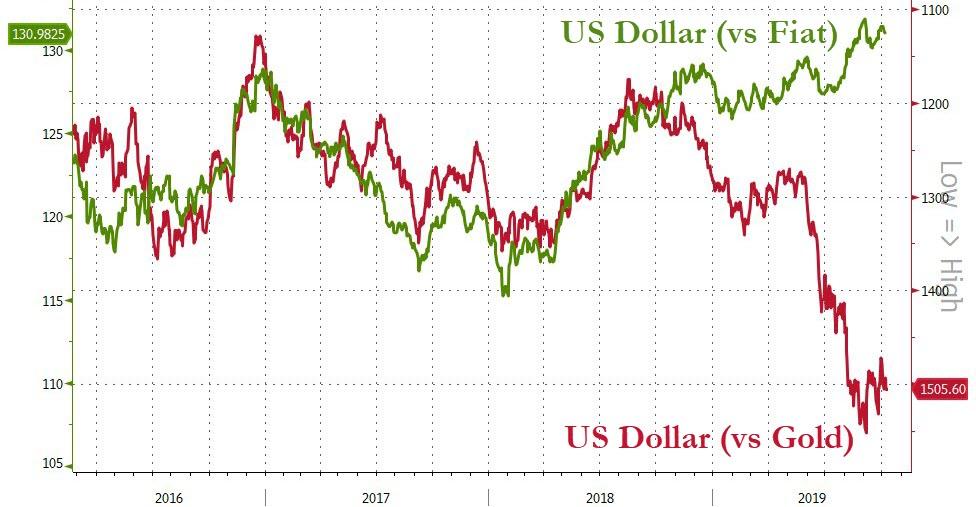
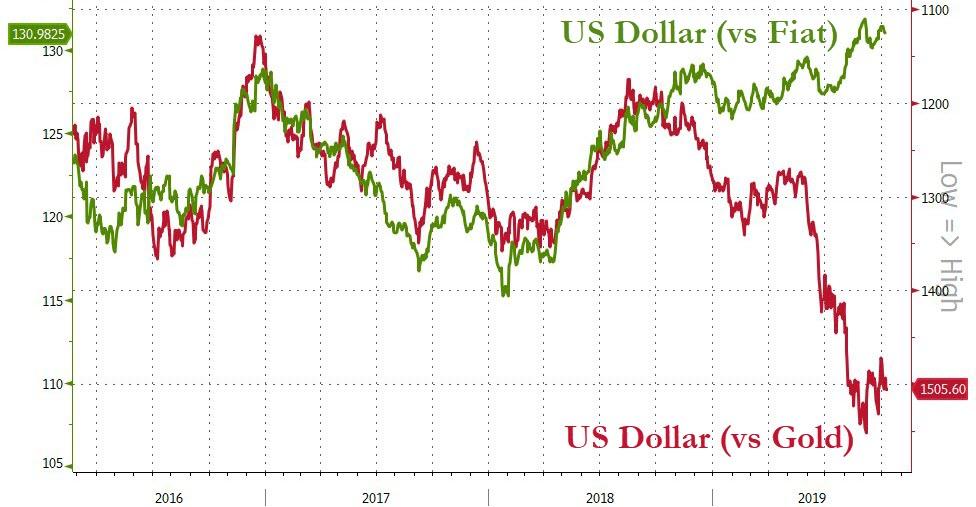
hasn’t happened yet. Gold has broken out. Gold is over $1,500 per ounce,
and it is hitting record highs in most currencies. Not in the dollar,
yet. The dollar is still relatively strong against other fiat
currencies, but the fact it is this weak against gold shows you there is
a lot of underlying weakness in the dollar that has yet to manifest . .
. but that is going to happen. When the dollar starts to fall, that’s
going to take the bond market down with it. Long term interest rates are
ultimately going to rise when the dollar tanks.”
Source: Bloomberg
Schiff also says, “I think gold is undervalued relative to where it should be because so many people have too much confidence in central banks and fiat money..."
"They don’t realize they need to own gold. I think they are going to come to that epiphany soon, and when they do, the price of gold is going to explode...
Gold is going to be money again. There is no question in my mind that is going to happen.”
ゴールドは再度マネーになろうとしている。そうなることに私は何の疑念も持っていない。」
Schiff predicts President Trump will not get re-elected but not
because of impeachment, but the failing economy. Schiff says, “The trade
deficits are bigger than they have ever been. They are bigger than they
were under Obama..."
"Manufacturing is already in recession, and it will be deeper in recession by the time the election comes. The numbers are the worst they have been since 2009.
Most blue collar voters who voted for Trump in 2016 will be worse off in 2020. They will have more debt, and they will have lower real wages if they even have jobs.
最後の二段落だけ訳しておきます。 Stock Euphoria Stunts Gold Adam Hamilton April 19, 2019 3257 Words The great euphoria emanating from these near-record-high stock markets is breathtaking. Traders are again convinced stocks do nothing but rally indefinitely. That everything-is-awesome mindset has stunted gold’s latest upleg, since there’s no perceived need for prudently diversifying stock-heavy portfolios. But that psychology can change fast, as we saw a half-year ago. Gold investment roars back as stocks roll over. The word “euphoria” is widely misunderstood, often confused with “mania”. The latter is when stocks rocket vertically in blowoff tops, and is defined as “an excessively intense enthusiasm, interest, or desire”. The US stock markets certainly aren’t in a mania. At its latest high last Friday, the flagship US S&P 500 broad-market s...