It's not just "tinfoil blogs" who (for the past 11 years)
have been warning that a monetary reset is inevitable and the only
viable fallback option once trust and faith in fiat is lost, is a gold
standard (something which even Mark Carney hinted at recently): central banks are joining the doom parade now too.
An article published by the De Nederlandsche Bank (DNB), or Dutch Central Bank, has shocked many with its claim that "if the entire system collapses, the gold stock provides a collateral to start over." De Nederlandshce Bank(DNB)もしくはDutch Central Bankの論文によると、彼らの主張が多くの人にショックを与えた「もし全金融システムが崩壊すると、ゴールド備蓄がシステム再起動の担保となる。」というものだ。
While gloomy predictions of a monetary reset are hardly new, they have
traditionally been relegated to the fringe of mainstream financial
thought - after all, as Mario Draghi stated on several occasions in
recent years, the mere contemplation of a "doomsday scenario" is enough
to create the self-fulfilling prophecy which materializes it. As such,
it is stunning to see a mainstream financial institution open up about
the superior value of limited supply, non-fiat, sound money assets.
It is also hypocritical given the diametrically opposed Keynesian
practices regularly engaged in by central banks and official
institutions worldwide: after all, just a few months back, the IMF published a paper bashing Germany's adoption of the gold standard in the 1870s as the catalyst for instability in the global monetary system.
Fast forward to today, when the Dutch Central Bank is admitting not
only did gold not destabilize the monetary system, but it will be its
only savior when everything crashes.
"If things go wrong, prices may fall. But, crisis or not, a gold bar
always holds value." This makes it the opposite of "shares, bonds and
other securities" all of which have inherent risk.
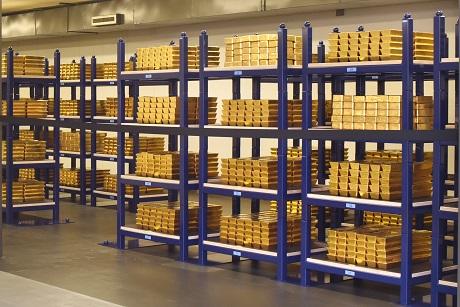
Photo of gold bars from the DNB's article "Goud van DNB."
According to the IMF's latest data, the DNB holds 615 tons (15,000
bars) of gold mainly in Amsterdam, with other stores in the U.K. and
North America; the value of this gold reserve is over €6 billion ($6.62
billion). Calling gold the “trust anchor,” the article details briefly
why the hard asset is so important to wealth building and the global
economy, claiming: "Gold is... the trust anchor for the
financial system. If the whole system collapses, the gold stock provides
a collateral to start over. Gold gives confidence in the power of the
central bank's balance sheet."
Why this sudden admission of what goldbugs have been saying for
years? Perhaps it has to do with the fact that on October 7, the bank announced it would soon be moving a large part of its gold reserves to "the new DNB Cash Center at military premises in Zeist."
Almost as if the Netherlands is preparing for the grand
reset, and is moving its most valuable asset to a "military"
installation just for that purpose.
それはまるでオランダが the grand reset に備えているかのようだ、そして最も価値のある資産を「軍隊」監督下に移動している。
As bitcoin.com tongue-in-cheek points out, "DNB is no stranger to
playing along with the Keynesian, inflationary games of the global
monetary system. A system which, according to some, is now more a Ponzi scheme based on force and blind faith than sound economic principle. That
notwithstanding, the centralized financial powers of the world know the
real score, and that’s why hard assets like gold are hoarded and locked
down while everyday, individual residents of these geopolitical
jurisdictions are encouraged to spend and spend, going further into debt
to prop up ultimately unsound national economies."
It is hardly a coincidence that in its preparation for monetary
doomsday, the Dutsch Central Bank is also set to begin cracking down on
crypto exchanges and wallets, stating that "firms offering services for
the exchange between cryptos and regular money, and crypto wallet
providers must register with De Nederlandsche Bank."
While the push for greater KYC/AML transparency is a growing global
trend, and is hardly surprising in a world in which trillions in assets
reside in "tax-evading" offshore jurisdiction, the remarkable aspect of
this latest crackdown against crypto - which many see as a modern, more
efficient form of "gold" - is the fact that invasive regulations and
restrictions by central banks can be seen as yet another means of
stockpiling precious assets. This time, not gold bars, but bitcoin and
crypto.
As for the timing of the "great monetary reset", which other central
banks have already quietly hinted at themselves amid massive
repatriation of physical gold from the New York Fed to various European
central banks such as Germany and Austria, we are confident
that the trust-keepers of the current establishment - such as other
central banks and the IMF - will be kind enough to provide ample advance
notice to the citizens of the "developed" world to exchange their fiat
into hard assets. Or, then again, perhaps not.
「great monetary reset」と期を同じくして、他国中央銀行もすでに密かに自国金塊をNew York Fedから幾つかの欧州各国の中央銀行に回帰させている、たとえばドイツとかオーストラリアだ、ZeroHedgeはこう確信している、他国中央銀行やIMFのような既存のイスタブリッシュ達のtrust-keeper は「先進国」の市民に対して管理通貨をハードアセットに交換するように知らしめるだろう。まあ、いつもの繰り返しだが、そうではないかもしれない。
Amazonで買物をしてContrarianJを応援しよう この長文記事をRay Dalioが発表し、ゴールドは$1400から$1420へと急騰しました。GLD保持高に変化はないのでたぶん先物ポジションが進んでいます。 Ray Dalio Warns A "New Paradigm" Is Coming: "Buy Gold, Sell Stocks" by Tyler Durden Wed, 07/17/2019 - 14:44 Authored by Ray Dalio via LinkedIn, One of my investment principles is: 私の投資原則はこういうものだ: Identify the paradigm you’re in, examine if and how it is unsustainable, and visualize how the paradigm shift will transpire when that which is unsustainable stops. 現在のパラダイムを認識し、それがどの程度持続可能かどうか判断する、そしてパラダイムシフトがどのように起きるか、そしてその着地点を思い描く。 Over my roughly 50 years of being a global macro investor, I have observed there to be relatively long of periods (about 10 years) in which the markets and market relationships operate in a certain way (which I call “paradig...
Amazonで買物をしてContrarianJを応援しよう 記事を紹介しようと訳を入れている間にFOMCが過ぎてしまいタイミングを逸してしまいました、前半は読み飛ばしてください。後半部分に関して、日本では一般会計と特別会計が別れていて政府財政がわかりにくいですが、米国は分離されておらず年金会計がより鮮明になります。$70Tって邦貨でいうと約7000兆円ですからね。 Whistling Past The $70 Trillion Debt Graveyard 07-26-19 Written by Lance Roberts | Jul, 27, 2019 Last week, we discussed the setup for a near-term mean reversion because of the massive extension above the long-term mean. To wit: 先週には、私どもは短期的な平均回帰のし掛けが出来上がっていることを議論した、というのも現在長期的な平均から極端に乖離しているからだ。見てみよう: “There is also just the simple issue that markets are very extended above their long-term trends, as shown in the chart below. A geopolitical event, a shift in expectations, or an acceleration in economic weakness in the U.S. could spark a mean-reverting event which would be quite the norm of what we have seen in recent years.” 「とてもかんたんなことだが、市場は長期的なトレンドからあまりに極端に上方乖離している、それは下のチャートを見れば明らかだ。地政学的出来事、期待値の変化、もしくは米国経済の弱さが加速するなら、平均回帰を引き起こすだろう、それは過去数年でみた典型的な相場の動きだ。」 This analysis is ...
Productivity: What It Is & Why It Matters Written by Michael Lebowitz | Jan, 16, 2019 The Kansas City Federal Reserve posted the Twitter comment and graph below highlighting a very important economic theme. Although productivity is a basic building block of economic analysis, it is one that few economists and even fewer investors seem to appreciate. Kansas 市FEDがツイッターにコメントを投稿した、そのグラフを下に示す、とても重要な経済テーマだ。経済分析においては生産性というのはとても重要な要素だが、ほとんどのエコノミストがこの件に言及しない、投資家は更にこのことを忘れ去っている。 The Kansas City Fed’s tweet is 100% correct in that wages are stagnating in large part due to low productivity growth. As the second chart shows, it is not only wages. The post financial-crisis economic expansion, despite being within months of a record for duration, is by far the weakest since WWII. Kansas City FEDのツイートは100%正しい、給与が停滞している原因の主要因は生産性成長が低いからだ。二番目のチャートを見ても判るように、成長鈍化は給与だけではない。あの金融危機後の経済拡大は、第二次世界大戦後で記録的長期の拡大期間だが、とても弱い拡大だ。 Productivity growth over the last 350+ years is ...
米国はよく理解してませんが、日本の場合では量的緩和で日銀が国債買い上げした資金は日銀当座預金にそのままです、市中には流れていません。でもNHKのニュース等では「ジャブジャブ」という表現をアナウンサーが使い、さらに丁寧に水道の蛇口からお金が吐き出される画像まで示してくれます。これって心理効果が大きいですよね。量的緩和とは何かを7時のニュースや新聞でこれ以上丁寧に解説するのはそう簡単ではありません。一般の人も株式をやっている人も「イメージ」で捉える以上はそう簡単にできません。多くの人は量的緩和とはなにか、を理解していないと私は想像しています。 ただし、国債を買い上げるので長期金利が低下し住宅ローン金利等が下がったのは確実な効果です。一方で長短金利差が少なくなると銀行のビジネスモデルが成り立たなくなりますが。 This Is The One Chart Every Trader Should Have "Taped To Their Screen" by Tyler Durden Sat, 01/19/2019 - 18:55 After a year of tapering, the Fed’s balance sheet finally captured the market’s attention during the last three months of 2018. 一年間のテーパリング後、FEDバランスシートがとうとう市場の注目をあびることになった、2018年の最後の3ヶ月だ。 By the start of the fourth quarter, the Fed had finished raising the caps on monthly roll-off of its balance sheet to the full $50bn per month (peaking at $30bn USTs, $20bn MBS...