もし中国がスーパーパワーを持ちたいなら、相応の規模の自国通貨を発行せねばならず、かつ世界の為替市場に価格発見能力を持たせねばならない。 Quick history quiz: in all of recorded history, how many
superpowers pegged their currency to the currency of a rival superpower? Put another way: how many superpowers have made their own currency dependent on another superpower's currency?
Only one: China. China pegs its currency, the yuan
(RMB) to the U.S. dollar. It adjusts the peg a bit here and there, but
the yuan's value is set by the Chinese state, not by the market of
buyers and sellers.
(Yes, various nations have used gold coins minted by rival powers
(Spanish pieces of eight were money everywhere, for example) but we're
talking about fiat currencies, backed by nothing but supply and demand, not intrinsically valuable gold coins.)
Second question: is pegging your currency to a rival power's currency a sign of strength? The
obvious answer is no. It's a sign of weakness. A real financial power
issues its own currency and let's the global FX (foreign exchange)
market discover the relative price / value of the currency. The
financial power trusts the market to discover the value / price of its
currency, and it responds by raising or lowering the yields on its
government bonds and other pricing inputs. If the issuing nation won't allow users and owners of its currency price discovery, few will want the currency because they can't trust the state's arbitrary, non-market price. This
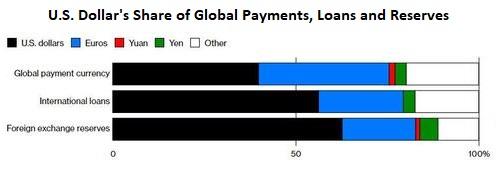
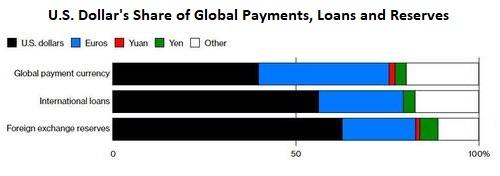
reality is reflected in the chart below of global currencies' relative
share in global payments, loans and reserves. China's currency, the yuan
(RMB) is basically signal noise: its global role in payments, loans and
reserves is near-zero.
Why does China cling to state control of its currency's valuation? The
obvious answer is that China's economy and global role are too fragile
to absorb a major revaluation of its currency up or down: a major loss
in purchasing power would raise the cost of energy and other imports,
while a major strengthening of the yuan would crush the global
competitiveness of China's goods and services. As for the idea that China will unpeg its currency when it
backs it with gold, recall that "backed by gold" means "convertible to
gold." If the yuan weakens and other nation-state owners of the
currency decide gold is the safer bet, China will have to exchange yuan
for gold if it wants to make good on its claim to be backing its
currency with gold.
どうして中国は自国通貨価値の国家支配にここまでこだわるのだろう?答えは明らかで、中国経済とその世界での役割はあまりに脆弱で通貨評価の上下を吸収できないということだ:大きく購買力が下がるとエネルギーや他の輸入コストを上げることになる、一方でRMBが大きく強くなると中国製品の世界的競争力を急落させてしまう。中国がペッグを止めてゴールド裏付けとする議論に関しては、「backed by gold」というのは「convertible to gold」ということだ。もしRMBが弱くなり他国が持つRMBをゴールドに変えたほうが安全と思うと、中国はRMBをゴールドに変えざるを得ない。
If the currency isn't convertible to gold, it isn't backed by gold at all; it's just another fiat currency backed by nothing.
ゴールド変換ができないなら、backed by gold とは全く言えない;全く裏付けのない別の管理通貨ということだ。
If China wants superpower status, it will have to issue its currency in size and let the global FX market discover its price. Anything less leaves China dependent on the U.S. and its currency, the dollar.
If China is so powerful, why doesn't it let its currency float on the
FX market like other trading nations? Until its currency floats freely
like other currencies and the yuan's price is discovered by supply and
demand, China's global role in currency payments, loans and reserves
will remain near-zero. That is a weakness that appears to be
insurmountable. もし中国が底まで力強いなら、どうして他国のように為替市場の変動相場通貨にしないのか?他国と同様にRMBが変動相場となりRMB価格が需給で決まるようにならないかぎり、支払い・債務・準備金における中国の通貨の役割はほとんどゼロのままだろう。これは明らかに克服できない弱さだ。
* * *
Amazonで買物をしてContrarianJを応援しよう この長文記事をRay Dalioが発表し、ゴールドは$1400から$1420へと急騰しました。GLD保持高に変化はないのでたぶん先物ポジションが進んでいます。 Ray Dalio Warns A "New Paradigm" Is Coming: "Buy Gold, Sell Stocks" by Tyler Durden Wed, 07/17/2019 - 14:44 Authored by Ray Dalio via LinkedIn, One of my investment principles is: 私の投資原則はこういうものだ: Identify the paradigm you’re in, examine if and how it is unsustainable, and visualize how the paradigm shift will transpire when that which is unsustainable stops. 現在のパラダイムを認識し、それがどの程度持続可能かどうか判断する、そしてパラダイムシフトがどのように起きるか、そしてその着地点を思い描く。 Over my roughly 50 years of being a global macro investor, I have observed there to be relatively long of periods (about 10 years) in which the markets and market relationships operate in a certain way (which I call “paradig...
Amazonで買物をしてContrarianJを応援しよう 記事を紹介しようと訳を入れている間にFOMCが過ぎてしまいタイミングを逸してしまいました、前半は読み飛ばしてください。後半部分に関して、日本では一般会計と特別会計が別れていて政府財政がわかりにくいですが、米国は分離されておらず年金会計がより鮮明になります。$70Tって邦貨でいうと約7000兆円ですからね。 Whistling Past The $70 Trillion Debt Graveyard 07-26-19 Written by Lance Roberts | Jul, 27, 2019 Last week, we discussed the setup for a near-term mean reversion because of the massive extension above the long-term mean. To wit: 先週には、私どもは短期的な平均回帰のし掛けが出来上がっていることを議論した、というのも現在長期的な平均から極端に乖離しているからだ。見てみよう: “There is also just the simple issue that markets are very extended above their long-term trends, as shown in the chart below. A geopolitical event, a shift in expectations, or an acceleration in economic weakness in the U.S. could spark a mean-reverting event which would be quite the norm of what we have seen in recent years.” 「とてもかんたんなことだが、市場は長期的なトレンドからあまりに極端に上方乖離している、それは下のチャートを見れば明らかだ。地政学的出来事、期待値の変化、もしくは米国経済の弱さが加速するなら、平均回帰を引き起こすだろう、それは過去数年でみた典型的な相場の動きだ。」 This analysis is ...
米国はよく理解してませんが、日本の場合では量的緩和で日銀が国債買い上げした資金は日銀当座預金にそのままです、市中には流れていません。でもNHKのニュース等では「ジャブジャブ」という表現をアナウンサーが使い、さらに丁寧に水道の蛇口からお金が吐き出される画像まで示してくれます。これって心理効果が大きいですよね。量的緩和とは何かを7時のニュースや新聞でこれ以上丁寧に解説するのはそう簡単ではありません。一般の人も株式をやっている人も「イメージ」で捉える以上はそう簡単にできません。多くの人は量的緩和とはなにか、を理解していないと私は想像しています。 ただし、国債を買い上げるので長期金利が低下し住宅ローン金利等が下がったのは確実な効果です。一方で長短金利差が少なくなると銀行のビジネスモデルが成り立たなくなりますが。 This Is The One Chart Every Trader Should Have "Taped To Their Screen" by Tyler Durden Sat, 01/19/2019 - 18:55 After a year of tapering, the Fed’s balance sheet finally captured the market’s attention during the last three months of 2018. 一年間のテーパリング後、FEDバランスシートがとうとう市場の注目をあびることになった、2018年の最後の3ヶ月だ。 By the start of the fourth quarter, the Fed had finished raising the caps on monthly roll-off of its balance sheet to the full $50bn per month (peaking at $30bn USTs, $20bn MBS...
Productivity: What It Is & Why It Matters Written by Michael Lebowitz | Jan, 16, 2019 The Kansas City Federal Reserve posted the Twitter comment and graph below highlighting a very important economic theme. Although productivity is a basic building block of economic analysis, it is one that few economists and even fewer investors seem to appreciate. Kansas 市FEDがツイッターにコメントを投稿した、そのグラフを下に示す、とても重要な経済テーマだ。経済分析においては生産性というのはとても重要な要素だが、ほとんどのエコノミストがこの件に言及しない、投資家は更にこのことを忘れ去っている。 The Kansas City Fed’s tweet is 100% correct in that wages are stagnating in large part due to low productivity growth. As the second chart shows, it is not only wages. The post financial-crisis economic expansion, despite being within months of a record for duration, is by far the weakest since WWII. Kansas City FEDのツイートは100%正しい、給与が停滞している原因の主要因は生産性成長が低いからだ。二番目のチャートを見ても判るように、成長鈍化は給与だけではない。あの金融危機後の経済拡大は、第二次世界大戦後で記録的長期の拡大期間だが、とても弱い拡大だ。 Productivity growth over the last 350+ years is ...