A recent article by James Deporre at thestreet.com asked Will Powell’s Remarks Push the Algos to Make a Move? 最近のthestreet.comでのJames Deporreの記事ではこう問いかける、Powellの発言がアルゴリズム取引で市場を動かすか?
Deporre’s article is a recap of a day’s market events beginning with
Jerome Powell’s recent testimony to Congress. He suggests that what
matters are not Powell’s words, but whether computerized trading
programs, known as “algos,” would buy stocks as a result of Powell’s
testimony. Summarizing what ended up being an uneventful day of trading
activity, Deporre made the following absurd comment which caught our
attention:
“On the other hand, the mighty Apple (AAPL) is holding up and seems to function as a de facto money market account these days. It is a great place for some to park cash and that helps to keep the indices hovering near highs.”
While we currently hold Apple stock on behalf of some of our
clients, we do so with the full awareness that valuations for Apple and
many other stocks are extreme. A reversion back to or below
average historical valuations will result in a massive loss of wealth
for many investors. As such, we maintain a careful and balanced
investment posture and take nothing for granted. Most importantly, we
never confuse “parking” cash with owning a stock. Like a shovel and
hammer, stocks and cash are valuable tools, but neither is a perfect
substitute for the other.
Apple is one of the world’s largest corporations, with innovative
products and a great growth trajectory. As reported in its third-quarter
2019 earnings release, the company has a war chest of $245 billion in
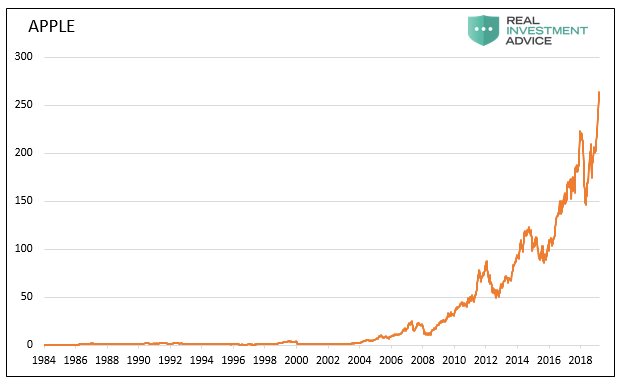
cash. These facts are not lost on investors. As shown below, Apple
shares have risen at a remarkable pace. Since its IPO in 1984, the stock
is up almost 70,000% or more than 20% annually. A $1500 investment in
1984 is now worth over a million dollars!
Data Courtesy Bloomberg
Money market mutual funds, also known as cash accounts, are vehicles
that allow investors to hold cash and earn the short term rate of
interest in the market. These funds invest in very short term, liquid,
and highly rated securities. The investments produce little to no price
volatility. Many money market mutual funds are governed by the SEC’s 2A7
rules, which greatly limit the credit and liquidity risk of these funds
and attempt to ensure investors in them do not have a risk of loss of
principal. Given the near riskless nature of money market mutual funds,
they offer meager returns.
As the Byrds sang, “there is a season- turn – turn- turn. Similarly,
there is a time to invest heavily in stocks and a time to scale back on
stock holdings and take less risk. It is all too popular for market
gurus, especially at market peaks when complacency is the highest, to
preach about buy and hold strategies. This advice is based on a
misconception that market drawdowns will be short-lived and investors
will quickly recoup any losses. Therefore, it is not surprising
that the popular investing view today insists that investors should
check their brains at the door and remain fully invested in stocks at
all times. Byrdsの歌にもあるように、「there is a season- turn - turn - turn、方針を変えるときがある、変えろ、変えろ、変えろ」。同様に、株式比重を大きくするときと株式露出を減らしリスクを抑えるときがある。市場になれた人にとってはあまりに一般的なことだ、特に安心感が高まり市場が頂点に達したときだ、buy &hold戦略が勧められなくなる。このアドバイスはこういう誤解に対するものだ、市場の下落は短期的なものであり投資家はどういう損失でもすぐに取り戻すことができる。しかるに驚くことではないが、現在の一般的な投資家はいつでも株式露出全開であり頭を冷やすべきだ。
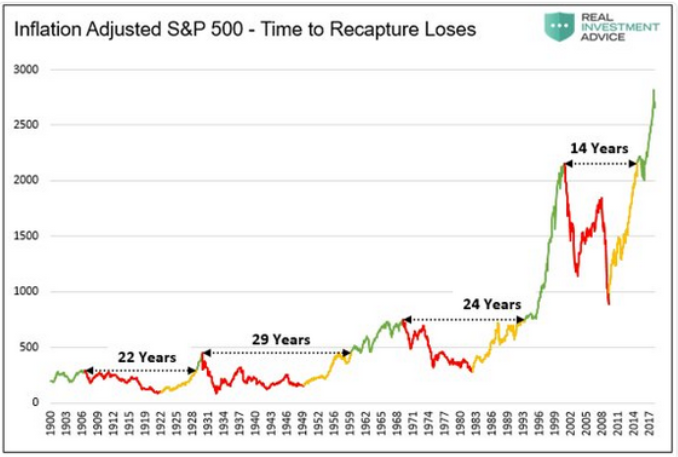
As shown below, such logic flies in the face of history.
下のチャートを見れば、歴史的にそういう論理が的を得ていることが解る。
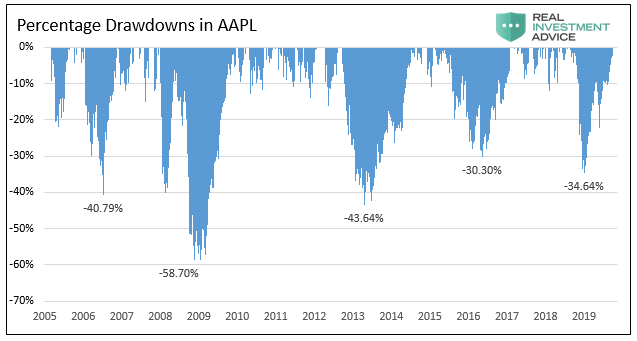
Over the long run, investors in Apple have fared better than the
market. As shown, drawdowns over the last decade have been relatively
short-lived. However, those setbacks have not been small. Since 2010,
Apple’s stock price has dropped by 35-45% on three different occasions
and by 20% on one other. So, can we treat Apple like a money market fund
and hold it with the certainty of knowing that it will never lose
value?
It is important to understand that, in the long run, stock prices are
regulated by the cash flows of the underlying corporation. We explained
this recently as follows:
“A Honus Wagner baseball card from 1909 was recently auctioned
for over $3 million. While that may seem like a lot of money, it is not
necessarily expensive. A baseball card is nothing more than paper and
ink with no real value. Its street value, or price, is based on the
whims of collectors. “Whim” is impossible to value.
Stocks are not baseball cards. Stocks represent ownership in a corporation, and therefore, their share prices are based on a series of future expected earnings
and cash flows. Further, there are many other types of investments that
serve not only as alternatives, but provide a means to assess relative
value.
Today, investors are trading stocks on a “whim,” with scant attention to their value. Unlike
a baseball card, when a stock’s market value rises much more than its
real value, an inevitable correction will occur. The only question is
not if, but when.”
There is an important distinction to be made here between “investing” vs. “speculating.”
そこには重要な違いがある、「投資」と「投機」だ。
Apple’s shares are priced at a historically steep premium to its
fundamentals, meaning “whim” is playing a role in recent price
appreciation. Whim is speculating. Here are a few fundamental data
points to consider, but as you do, keep in mind Apple has bought back a
third of their shares outstanding since 2012, making per share data when
adjusted for buybacks higher than that shown below.
Price to book value is the highest it has ever been since the IPO (12.90x)
PBRはIPO以来最高値だ、12.90x。
Price to earnings (trailing twelve months), price to sales, and price to free cash flow are at the highest levels since 2009
TTM PER、一株あたり売上、そして一株あたりフリーキャッシュは2009年以来最高だ
Regardless of whether Apple’s valuation may appear rich,
there is little doubt the valuation premium can still rise further in
the future. Earnings can grow faster than expected and justify
the current valuations. However, the premium can also revert back to
historical levels and earnings may disappoint in the future. Apple’s
stock price dropped 61% in 2008, and that was following the release of
the first iPhone. It is difficult to imagine a better time to have owned
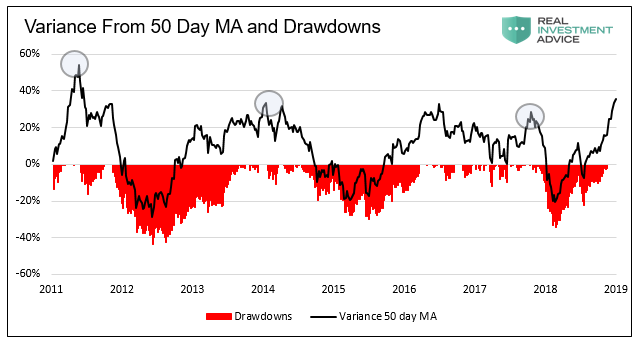
shares in the company. Apple also appears to be over extended on a technical basis.
The graph below shows the premium or discount of Apple stock price to
its 50 day moving average. As circled, three of the last four times that
the stock has been this far above the moving average, a drawdown of at
least 20% occurred.
Data Courtesy Bloomberg
Our simple conclusion is that Apple is a speculative investment with
zero guarantees and, therefore a poor substitute for a money market
fund.
Sorry Mr. Deporre, but Apple is not cash. When markets drop in
earnest, so will Apple, as suggested by its beta to the S&P 500 of
1.06. Holding Apple shares will not afford you the ability to
take advantage of lower prices when stocks go on sale. Therein lies an
important difference between the utilization of cash and stocks in a
portfolio. Mr. Deporreには申し訳ないが、Appleは現金とはわけが違う。相場が深刻な下落となると、Appleも同様だろう、S&P500に対するベータが1.06ということでも解るだろう。相場が下落した時Apple株を持っているからと言って有利なことは何も無い。現金ポジションを持つこととキャッシュを持つことの違いの重要性に関する嘘がまかり通っている。
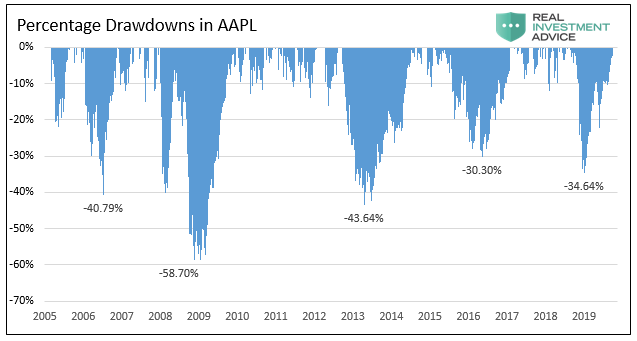
The graph below shows the percentage drawdowns that occurred in Apple’s stock over the last fifteen years.
下のグラフはApple株の過去15年の下落割合を示す。
Data Courtesy Bloomberg
Summary 要約
There are two key points that Deporre’s article fails to consider. Deporreの記事が考慮していない重要な点が2つある。
First, an equity stake in any company – whether a boring utility or hot IPO – is speculative, especially when valuations are above fair value. Value is never guaranteed, but it is far less uncertain when the price paid is below fair value.
Second, cash is king when markets decline. Investors
that are fully invested with little cash as an insurance policy tend to
sell when markets decline rapidly. Quite often, a low is marked with a
massive amount of capitulation selling. Those who harvest gains when
markets are over-valued and hold a reasonable amount of their portfolio
in cash can buy stocks that trade at a discount to fair value from those
who are panicking.
第2、相場が下落するときは cash is king だ。ほとんど現金を持たつ全面露出の投資家は相場急落の時安全のために売る傾向にある。度々見られることだが、強制的な巨額の降伏的売りを引き起こす。市場が過剰なバリュエーションになったときに利益を確定し現金をかなり持つ投資家だけが皆がパニックになったときに割安のフェアバリューで株式を購入できる。
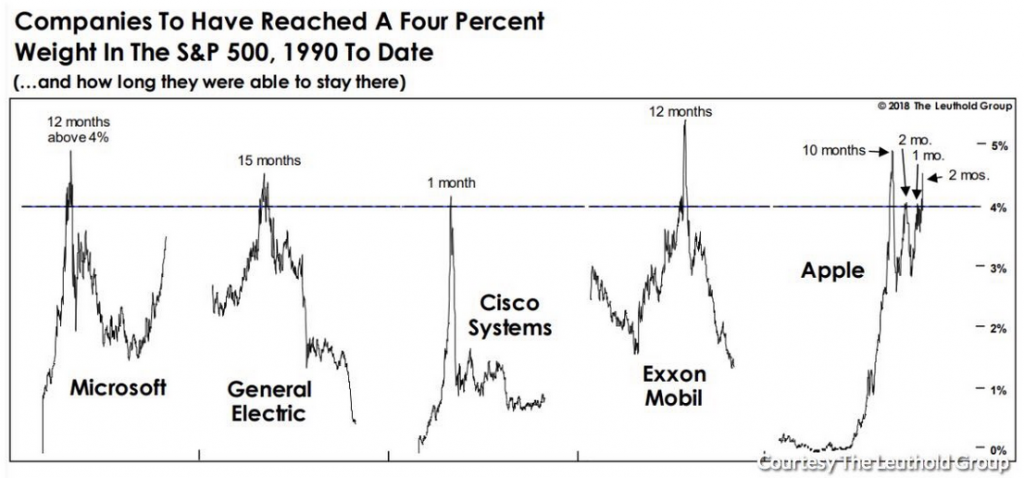
We leave you with an interesting graph from The Leuthold Group.
Amazonで買物をしてContrarianJを応援しよう Silver Outperforming Gold 2 Adam Hamilton July 26, 2019 3232 Words Silver has blasted higher in the last couple weeks, far outperforming gold. This is certainly noteworthy, as silver has stunk up the precious-metals joint for years. This deeply-out-of-favor metal may be embarking on a sea-change sentiment shift, finally returning to amplifying gold’s upside. Silver is not only radically undervalued relative to gold, but investors are aggressively buying. Silver’s upside potential is massive. ここ2週シルバーは急騰した、ゴールドを遥かに凌ぐものだ。これは注目すべきことだ、もう何年もシルバーはひどいものだった。この極端に嫌われた金属が大きく心理を買えている、とうとうゴールド上昇を増幅するに至った。シルバーは対ゴールドで極端に過小評価されているだけでなく、投資家は積極的に買い進んでいる。シルバーの潜在上昇力は巨大なものだ。 Silver’s performance in recent years has been brutally bad, repelling all but the most fanatical contrarians. Historically silver prices have been mostly ...
多量のオピオイドを米国に送り込み、米国で深刻な麻薬中毒問題を引き起こしています。現代版「阿片戦争」です。あのトヨタ初の女性取締役もオピオイド中毒で逮捕解任されましたよね。 US Is Dependent On China For Almost 80% Of Its Medicine by Tyler Durden Fri, 05/31/2019 - 12:55 Experts are warning that the U.S. has become way too reliant on China for all our medicine , our pain killers, antibiotics, vitamins, aspirin and many cancer treatment medicine. 専門家はこう警告する、米国はすべての医薬品、痛み止め、抗生物質、ビタミン、アスピリン、各種抗がん剤で、中国依存度が高すぎる。 Fox Business reports that according to FDA estimates at least 80 percent of active ingredients found in all of America’s medicine come from abroad, primarily from China . And it’s not just the ingredients, China wants to become the world’s dominant generic drug maker. So far Chinese companies are making generic for everything from high blood pressure to chemotherapy drugs. 90 percent of America’s prescriptions a...
結局、中国は隣国日本で20年前に起きたことを学んでいなかったということでしょう、というかどの国もどの政府も十分成熟するまでは「わかっちゃいるけどやめられない」ということでしょうね、きっと。 Spooked By Apple? Wait ‘Til China’s Bubble Bursts Written by Jesse Colombo | Jan, 3, 2019 Apple stock plunged nearly 10% on Thursday after the company cut its revenue forecast due to slowing iPhone sales in China. Apple’s woes dragged U.S. stock indices lower by more than 2% as fears of a more extensive China-driven slowdown spread. アップルの株価は火曜に約10%下落した、同社が中国でのiPhone売上原則を予想したためだ。アップルの弱さが米国株式指数を2%以上押し下げた、中国主導でさらなる原則が広がるのではという懸念からだ。 From the New York Times : ニューヨークタイムスによると: For years, no matter what was happening elsewhere, global companies bet billions upon billions of dollars that China’s consumers would keep spending money. 長年、他国で何が起きようとも多国籍企業は中国消費は巨額を維持することに賭けてきた。 Now, just when the world economy could use their financial firepower, they are no longer so quick to open their wallets. 今や、世界経済が金融弾薬を用いてももはや彼らの財布を緩めることはできない。 The latest sign of a slowdown in...
Gold Stocks Surge Higher Adam Hamilton February 22, 2019 2932 Words The gold miners’ stocks surged strongly this week, blasting to new upleg highs. The mounting gains are naturally driving more interest in this small contrarian sector, shifting sentiment towards bullish. Despite their accelerating rally, gold stocks still remain fairly low technically and deeply undervalued relative to gold. So their strengthening upleg likely has plenty of room to run considerably higher in coming months. 今週金鉱株は力強く上昇し新高値となった。上昇が積み上がりこの小さなコントラリアンセクターはさらに注目を集めている、これが心理を強気なものにする。ラリーが加速するが、金鉱株はテクニカル的にはまだ安値で、対ゴールドでとても過小評価されている。というわけで力強い上昇は今後数ヶ月まだかなりな上昇余地がある。 The gold miners’ stocks are ultimately leveraged plays on gold, which overwhelmingly drives their profits. The much-maligned yellow metal has enjoyed a strong upleg since mid-August, when record gold-futures s...
S&P Surges To Key Technical Level - Now What? by Tyler Durden Tue, 02/12/2019 - 12:03 Having failed twice last week, the S&P 500 is once again testing its 200DMA as hopes of a border/shutdown deal, a lack of collusion, China trade dreams, and an easy Fed are prompting stocks to new post-Xmas dip highs... 先週二回失敗し、S&P500がまたもや200日移動平均に挑戦している、国境の壁/政府閉鎖問題解決、ロシア疑惑解消、中国貿易改善そしてFEDのハト派姿勢、これらがクリスマス下落後の高値を推進している・・・ The S&P 500 is at its highest since Dec 4th... S&P500は12月4日以来の高値だ・・・ What happens next? では次はどうなる? Earnings recession? Meh, don't worry about it... 収益による景気後退? 別に心配することではない・・・・ Oh and don't worry - Fed Chair Powell just told everyone that he "doe...