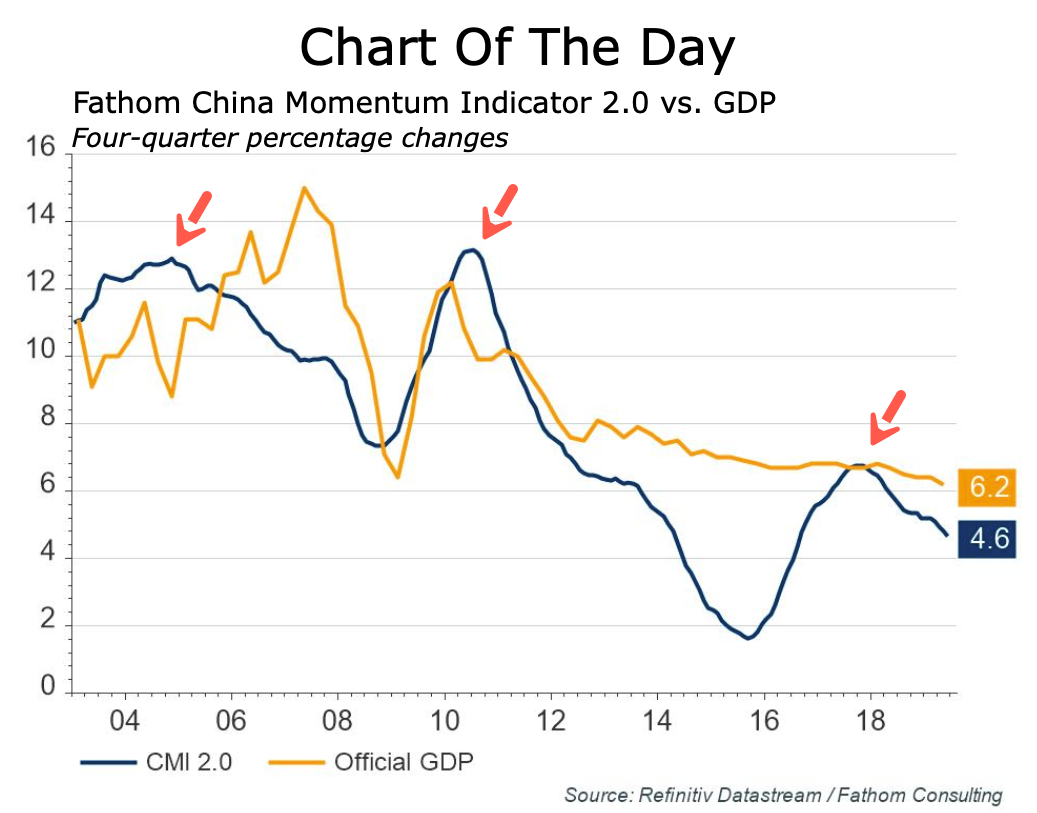
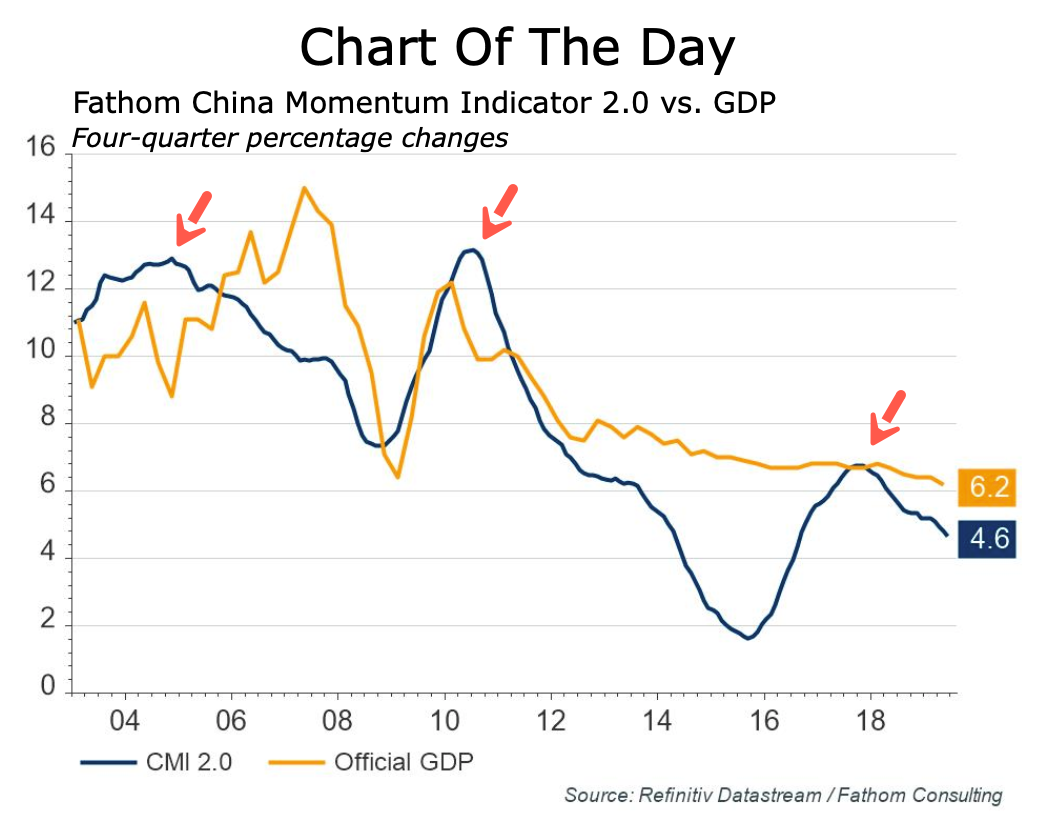
According to Fathom Consulting,
a global independent macro research consultancy, it's proprietary China
Momentum Indicator 2.0 has slowed to 4.6% in June, the lowest reading since Aug. 2016.
独立系世界マクロコンサルタント Fathom Consultingによると、彼ら独自のChina Momentum Indicator 2.0が6月に4.6%まで減速した、2015年8月以来の低位だ。
There is also a growing gap between the China Momentum Indicator 2.0 at 4.6% and official GDP data at 6.2%. Might suggest China's economy hasn't yet bottomed, could continue to decline through 2H19 into 1H20.
China Momentum Indicator 2.0の4.6%と公式GDPデータ6.2%の間には大きな乖離がある。ということは中国経済はまだ底入れしていないことを示唆している、2019H2から2020H1にかけてさらに下落の可能性がある。
Gary Cohn, the former chief economic advisor to Donald Trump, has
said the slowdown predates the trade war and reflects a strategic
decision by China to rebalance the economy.
トランプ政権の元主任経済アドバイザ Gary Cohnによると、中国経済減速は貿易戦争前から始まっており、中国の経済再構築戦略を反映している。
Fathom notes that China's economy was even slowing before the rebalancing. Fathomの報告では、中国経済は再構築前から減速していた。
The global macro research firm said, "with the consumer share of total import demand on a downward trend since 2016, we also find little evidence to suggest that China is successfully rebalancing."
To combat dangerous crosscurrents of the trade war disrupting global
supply chains in and out of China, Chinese policymakers resorted to the
same playbook as before, pump the economy with record amounts of the
stimulus earlier in the year.
Currency depreciation came into the picture when President Trump
escalated the trade war by raising tariffs to 25% from 10% on $200
billion of Chinese goods in May. Then a massive devaluation of the
renminbi followed in early August, when the president slapped 10%
tariffs on $300 billion worth of Chinese goods, effective Sept. 1.
"Trade talks are continuing, and during the talks the U.S. will
start, on Sept. 1, putting a small additional Tariff of 10% on the
remaining 300 Billion Dollars of goods and products coming from China
into our Country...We look forward to continuing our positive dialogue
with China on a comprehensive Trade Deal, and feel that the future
between our two countries will be a very bright one!" Trump said in a
tweet last month.
Since the trade war began last March, the renminbi has
weakened 13% against the U.S. dollar, neutralizing some of the tariffs
imposed by the U.S. on imports from China. 昨年3月に貿易戦争が始まって以来、人民元は対米ドルで13%弱くなっている、これが米国の関税強化をある程度緩和している。
Currency devaluation undermines hopes for a soft landing, while
further infuriating the Trump administration who has recently branded
China as a currency manipulator.
And for more bad news, China has said its rebalancing will continue
through 2020 and offered a pessimistic view of how Beijing won't sign a
trade deal until after the November 2020 election. This would almost
guarantee China is allowing its export economy to weaken while
stimulating its domestic economy, all in the attempt to trigger a
recession in the U.S. to diminish President Trump's probabilities of
getting reelected.
Amazonで買物をしてContrarianJを応援しよう この長文記事をRay Dalioが発表し、ゴールドは$1400から$1420へと急騰しました。GLD保持高に変化はないのでたぶん先物ポジションが進んでいます。 Ray Dalio Warns A "New Paradigm" Is Coming: "Buy Gold, Sell Stocks" by Tyler Durden Wed, 07/17/2019 - 14:44 Authored by Ray Dalio via LinkedIn, One of my investment principles is: 私の投資原則はこういうものだ: Identify the paradigm you’re in, examine if and how it is unsustainable, and visualize how the paradigm shift will transpire when that which is unsustainable stops. 現在のパラダイムを認識し、それがどの程度持続可能かどうか判断する、そしてパラダイムシフトがどのように起きるか、そしてその着地点を思い描く。 Over my roughly 50 years of being a global macro investor, I have observed there to be relatively long of periods (about 10 years) in which the markets and market relationships operate in a certain way (which I call “paradig...
Amazonで買物をしてContrarianJを応援しよう 記事を紹介しようと訳を入れている間にFOMCが過ぎてしまいタイミングを逸してしまいました、前半は読み飛ばしてください。後半部分に関して、日本では一般会計と特別会計が別れていて政府財政がわかりにくいですが、米国は分離されておらず年金会計がより鮮明になります。$70Tって邦貨でいうと約7000兆円ですからね。 Whistling Past The $70 Trillion Debt Graveyard 07-26-19 Written by Lance Roberts | Jul, 27, 2019 Last week, we discussed the setup for a near-term mean reversion because of the massive extension above the long-term mean. To wit: 先週には、私どもは短期的な平均回帰のし掛けが出来上がっていることを議論した、というのも現在長期的な平均から極端に乖離しているからだ。見てみよう: “There is also just the simple issue that markets are very extended above their long-term trends, as shown in the chart below. A geopolitical event, a shift in expectations, or an acceleration in economic weakness in the U.S. could spark a mean-reverting event which would be quite the norm of what we have seen in recent years.” 「とてもかんたんなことだが、市場は長期的なトレンドからあまりに極端に上方乖離している、それは下のチャートを見れば明らかだ。地政学的出来事、期待値の変化、もしくは米国経済の弱さが加速するなら、平均回帰を引き起こすだろう、それは過去数年でみた典型的な相場の動きだ。」 This analysis is ...
米国はよく理解してませんが、日本の場合では量的緩和で日銀が国債買い上げした資金は日銀当座預金にそのままです、市中には流れていません。でもNHKのニュース等では「ジャブジャブ」という表現をアナウンサーが使い、さらに丁寧に水道の蛇口からお金が吐き出される画像まで示してくれます。これって心理効果が大きいですよね。量的緩和とは何かを7時のニュースや新聞でこれ以上丁寧に解説するのはそう簡単ではありません。一般の人も株式をやっている人も「イメージ」で捉える以上はそう簡単にできません。多くの人は量的緩和とはなにか、を理解していないと私は想像しています。 ただし、国債を買い上げるので長期金利が低下し住宅ローン金利等が下がったのは確実な効果です。一方で長短金利差が少なくなると銀行のビジネスモデルが成り立たなくなりますが。 This Is The One Chart Every Trader Should Have "Taped To Their Screen" by Tyler Durden Sat, 01/19/2019 - 18:55 After a year of tapering, the Fed’s balance sheet finally captured the market’s attention during the last three months of 2018. 一年間のテーパリング後、FEDバランスシートがとうとう市場の注目をあびることになった、2018年の最後の3ヶ月だ。 By the start of the fourth quarter, the Fed had finished raising the caps on monthly roll-off of its balance sheet to the full $50bn per month (peaking at $30bn USTs, $20bn MBS...
多量のオピオイドを米国に送り込み、米国で深刻な麻薬中毒問題を引き起こしています。現代版「阿片戦争」です。あのトヨタ初の女性取締役もオピオイド中毒で逮捕解任されましたよね。 US Is Dependent On China For Almost 80% Of Its Medicine by Tyler Durden Fri, 05/31/2019 - 12:55 Experts are warning that the U.S. has become way too reliant on China for all our medicine , our pain killers, antibiotics, vitamins, aspirin and many cancer treatment medicine. 専門家はこう警告する、米国はすべての医薬品、痛み止め、抗生物質、ビタミン、アスピリン、各種抗がん剤で、中国依存度が高すぎる。 Fox Business reports that according to FDA estimates at least 80 percent of active ingredients found in all of America’s medicine come from abroad, primarily from China . And it’s not just the ingredients, China wants to become the world’s dominant generic drug maker. So far Chinese companies are making generic for everything from high blood pressure to chemotherapy drugs. 90 percent of America’s prescriptions a...