Authored by Mike Shedlock via MishTalk,
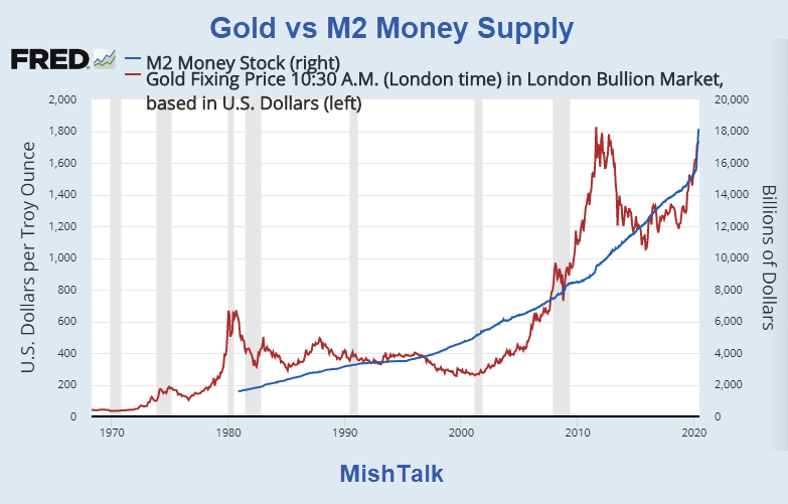
M2 Money Supply is surging. Will gold follow? M2マネーサプライが急増している。ゴールドはこれを追従するだろうか?
Let's investigate an alleged relationship between gold and M2, a measure of money supply in the US.
よく言われるM2(米国のマネーサプライ指標)とゴールドの関係について調べてみよう。
"There’s a clear correlation between the annual growth rate in M2 money supply and the price of the yellow metal. "
「M2の年率増加速度とゴールド価格の間には明らかな相関がある。」
Clear Correlation? 明らかな相関?
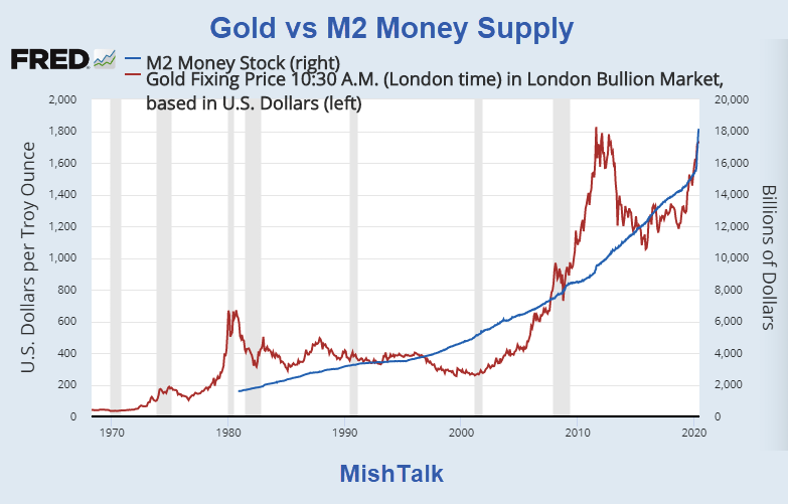
The Tweet claims something different than my lead chart depicts. So let's investigate the above idea in other time frames.
If we look at longer time frames, the rate of increase in M2 theory falls flat on its face.
もっと長期間を見ると、M2増加率理論は意味を成さないことが解る。
One can force a correlation starting in 2010 but that is purposeful
cherry-picking a timeframe. and even then, the time period in the box is
counter-trend.
Similarly, one can find times when gold is correlated to the dollar,
the Yen, and most likely the popularity of peanuts at Cub games in some
time frame.
The best correlation I can find to the price of gold is faith in
central banks. Gold collapsed from $850 to $250 under Greenspan's "Great
Moderation". Greenspan was viewed as the "Maestro" until the dot-com
bubble collapsed.
Gold went on a tear during the housing bubble, but put in a top when ECB president Mario Draghi gave his famous speech: "We will do whatever it takes to save the Euro, and believe me it will be enough."
Draghi did nothing. His speech was enough. Bond yields on Greek,
Portuguese, and Italian bonds started collapsing right after that
speech. It was not until years later the ECB resorted to negative
interest rates and QE.
Gold started rising again when the ECB went nuts with QE and the Fed
started talking about "normalization"that anyone in their right mind
knew was not coming.
The BIS did a historical study and found routine price deflation was not any problem at all.
BISは長年物価デフレを研究してきた、そこに何ら問題はないという。
"Deflation may actually boost output. Lower prices increase real
incomes and wealth. And they may also make export goods more competitive,” stated the study.
It’s asset bubble deflation that is damaging. When asset bubbles burst, debt deflation results.
資産バブルデフレは損失を生み出す。資産バブルが破裂すると、債務デフレが生み出される。
Central banks’ seriously misguided attempts to defeat routine
consumer price deflation is what fuels the destructive build up of
unproductive debt and asset bubbles that eventually collapse.
コメント欄に詳しい解説が書き込まれています。 英語でいうところの「buy back」と「insider buy」は異なる概念です。日本語の記事でどちらも自社株買いとされていることがあり、これを混同すると意味不明の記事になってしまいます。 The Great Stock Buyback Debate Written by Lance Roberts | May, 2, 2019 I recently wrote about stock buybacks in our weekly newsletter. However, a recent report from Axios noted that for 2019, IT companies are again on pace to spend the most on stock buybacks this year, as the total looks set to pass 2018’s $1.085 trillion record total. 最近私は週間記事で自社株買いに関して議論した。しかしながら、Axiosの最近の2019報告書によると、IT企業は再び今年その規模を増やしている、2018年は$1.085Tと記録的規模だったが、今年はこれを超えそうだ。 “By the numbers: Companies so far have spent $272 billion on buybacks, data compiled by Mike Schoonover, COO of Catalyst Funds, for Axios shows. 「数値を見る限り:企業は$272Bをすでに自社株買いに費やした、数値の解釈はMike Schoonoverによるものだ、彼はCatalyst FundsのCOOだ、Axiosがデータを示す。 Between the lines: The amount of spending on buybacks announced by companies in the IT sector has fallen significantly this year as other i...
米国はよく理解してませんが、日本の場合では量的緩和で日銀が国債買い上げした資金は日銀当座預金にそのままです、市中には流れていません。でもNHKのニュース等では「ジャブジャブ」という表現をアナウンサーが使い、さらに丁寧に水道の蛇口からお金が吐き出される画像まで示してくれます。これって心理効果が大きいですよね。量的緩和とは何かを7時のニュースや新聞でこれ以上丁寧に解説するのはそう簡単ではありません。一般の人も株式をやっている人も「イメージ」で捉える以上はそう簡単にできません。多くの人は量的緩和とはなにか、を理解していないと私は想像しています。 ただし、国債を買い上げるので長期金利が低下し住宅ローン金利等が下がったのは確実な効果です。一方で長短金利差が少なくなると銀行のビジネスモデルが成り立たなくなりますが。 This Is The One Chart Every Trader Should Have "Taped To Their Screen" by Tyler Durden Sat, 01/19/2019 - 18:55 After a year of tapering, the Fed’s balance sheet finally captured the market’s attention during the last three months of 2018. 一年間のテーパリング後、FEDバランスシートがとうとう市場の注目をあびることになった、2018年の最後の3ヶ月だ。 By the start of the fourth quarter, the Fed had finished raising the caps on monthly roll-off of its balance sheet to the full $50bn per month (peaking at $30bn USTs, $20bn MBS...
Amazonで買物をしてContrarianJを応援しよう Here Are The Recession Warning Signs To Watch by Tyler Durden Thu, 06/13/2019 - 10:25 Authored by Jesse Colombo via RealInvestmentAdvice.com, Last week, I wrote a detailed piece in which I explained that U.S. recession risk was rising quite rapidly and that the coming recession is likely to be far more severe than most economists expect because there are so many dangerous new bubbles inflating currently and because the global debt burden is much worse today than it was before the Great Recession . In the current piece, I will show more warning signs of the coming recession as well as discuss reliable recession indicators to keep an eye on as we get closer to the recession. 先週のことだ、米国の景気後退リスクが急速に高まっていることを詳細に解説した、そして次の景気後退は多くのエコノミストが予想するよりも遥かに深刻なものになりそうだ、その理由は、現在あまりに多くの新たなバブルが膨れ上がっており、また現在の世界債務負荷はあの金融危...
このブログ左の参考図書の一つがHoward Marksの本です。初めてこの本を読んだ時、管理人は目からウロコが取れた思いでした。 Howard Marks: "We Had One Of The Most Violent Downdrafts I Had Ever Seen" by Tyler Durden Mon, 01/14/2019 - 09:28 Right around the market peaked on September 2018, Oaktree's iconic founder Howard Marks published a letter to investors in which he warned that the market conditions made it "a time for caution", to wit: 市場がピークを迎えた2018年9月ころ、Oaktreeの伝説的創業者 Howard Marksが投資家向けレターを発行した、この中で市場環境は「注意すべき時だ」と警告した、見てみよう: I’m absolutely not saying people shouldn’t invest today, or shouldn’t invest in debt. Oaktree’s mantra recently has been, and continues to be, “move forward, but with caution.” The outlook is not so bad, and asset prices are not so high, that one should be in cash or near-cash. The penalty in terms of likely opportunity cost is just too great to ...
The US Consumer Just Hit A Brick Wall: Here's Why In 15 Charts by Tyler Durden Tue, 03/05/2019 - 17:05 When it comes to the growth dynamo behind the global economy, nobody can match the US consumer - not even China: accounting for trillions in annual spending, the US consumer, who represents roughly 70% of US GDP, is also responsible for roughly 17% of global GDP, slightly ahead of the entire country of China. 世界経済の成長エンジンを議論する時、米国消費以上のものはないーー中国ではない:年間トリリオンドルを米国消費者は使っている、これが米国GDPの70%、そして世界GDPの17%を占める、中国全GDPよりも大きい。 However, as recent economic data has shown, the future of the US consumer is suddenly looking ominously cloudy, for two big reasons: rising interest rates, which as Deutsche Bank notes are "beginning to bite" as observed in the number of working hours in sector selling big ticket items... しかしながら最近の経済デ...